
SEATTLE — Given a few bogus details and a little prodding, about a quarter of adults can be convinced they remember childhood adventures that never happened. Continue reading
Documents
Documents relating to ‘the Holocaust’
Studies suggest false memories can be ingrained
SEATTLE — Given a few bogus details and a little prodding, about a quarter of adults can be convinced they remember childhood adventures that never happened. Continue reading
Holocaust Museum Head Resigns
WASHINGTON (AP) — The newly selected director of the United States Holocaust Museum, under fire for questionable academic conduct, has resigned just two weeks before he was to take office.
Steven R. Katz sent a letter of resignation to the museum Friday, saying the “frivolous and non-meritorious allegations which have been asserted would unduly distract” from the work of the museum.
After carrying out an investigation, the museum’s board said a week ago that it would stand by Katz, who was scheduled to succeed founding director Jeshajahu Weinberg on March 16.
In accepting Katz’ letter of resignation, museum chairman Miles Lerman said he was saddened and continues to hold Katz’ “integrity, intellectual vision and scholarship on the Holocaust in the highest regard.”
Museum spokeswoman Mary Morrison said Katz was at his home in Binghamton, N.Y., and not reachable for comment on his decision.
Katz became a tenured Cornell professor in 1984.In March 1991, the Ivy League school barred him from future study leaves because he taught at the University of Pennsylvania in 1989 while on a half-year’s study leave.
“While we can study on sabbatical leave, we can’t teach on study leave, but I did not know that,” Katz said in recent telephone interview.”It was completely out of ignorance.”
In resumes and university documents dating back to 1983, Katz also described a Holocaust book he was working on as “being prepared for publication.”
But the project swelled into a multivolume work, and the first volume was not published until last year. In 1991 Katz had his salary frozen for three years for claiming his Holocaust book was near publication when it wasn’t.
Katz called his missteps technical violations, but Cornell officially censured him, finding him guilty on both counts of “academic misconduct.”
“I made two unintentional and regrettable errors,” Katz said.
In his letter of resignation Katz said he appreciated the museum’s support but “I have concluded that our mutual interests will best be served by my returning to academic life.”
Copied from the PRODIGY(R) service 03/04/95 09:42
New poll: Few deny Holocaust
NEW YORK — Americans have a shallow knowledge of the Nazi Holocaust but few doubt that it happened, according to an American Jewish Committee report correcting a misleading survey that caused alarm last year. Continue reading
Questioned Holocaust, historian badly beaten
A leading French revisionist historian who denies that millions of Jews were killed in the Holocaust was recovering from surgery yesterday after a savage beating.
Continue reading
Memory is fallible
Trials of an Expert Witness
- Research into memory shows that people often remember things differently from the way they were
A Brief History of Communications Intelligence in the United States
SRH-149
Continue readingREVIEWER’S NOTE:
This document, designated SRH-149 in the records of the National Archives, Washington, D.C., was prepared 21-27 March, 1952, by Captain Laurance F. Safford, United States Navy with special reference to coordination and cooperation and access to various historical records, with the objective of bringing diverse documents into a usable narrative history of a Naval activity. The document does not constitute an official Navy history, and no claims are made regarding its completeness or accuracy. On 6 March 1982 it was further certified to be declassified by the Director, National Security Agency.
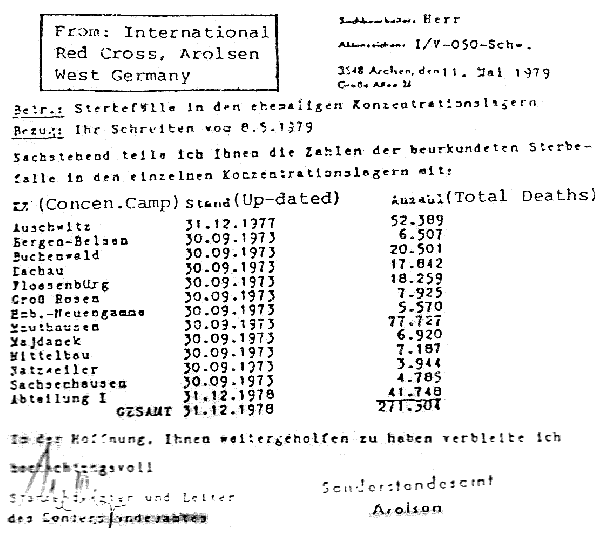
Red Cross Concentration Camp Report
German Corpse Factories
Even the most popular atrocity story of all — the German corpse factory — turned out to be another war correspondents’ invention. This particular story had a long and highly successful run. It had several variations, but basically it was that close behind their front line the Germans had established factories for boiling down the corpses of their soldiers, from which to distill glycerine for munitions. The Times initiated the story, on April 16, 1917, with a suspiciously vague paragraph that said baldly: “One of the United States consuls, on leaving Germany in February, stated in Switzerland that the Germans were distilling glycerine from the bodies of their dead.” The account quickly blossomed. The Times expanded the original report by reproducing a dispatch by a German correspondent, Karl Rosner, in which he referred to the German army’s Kadaververwertungsanstalt, which The Times translated as “Corpse Exploitation Establishment.” Foreign newspapers picked up the story. It appeared in LInde’pendance and La Belge, two Belgian newspapers published in France and Holland. French correspondents were instructed by their army authorities to send dispatches to their newspapers over their own signatures detailing what was known about the corpse factories. The matter came up in the House of Commons on April 30, when the Prime Minister was asked if he would make the story known as widely as possible in Egypt, India, and the East generally. A corpse-factory cartoon appeared iii Punch, and in general the affair had world-wide circulation and considerable propaganda value.
Toxicity of diesel exhaust
It has been suggested that fumes from diesel engines make an important contribution to atmospheric pollution. This is probably because they are sometimes highly irritant and sometimes very smoky. It is well known that, because of their comparatively low carbon monoxide content, these fumes are much less lethal than those from petrol engines.
Continue reading